
What changed
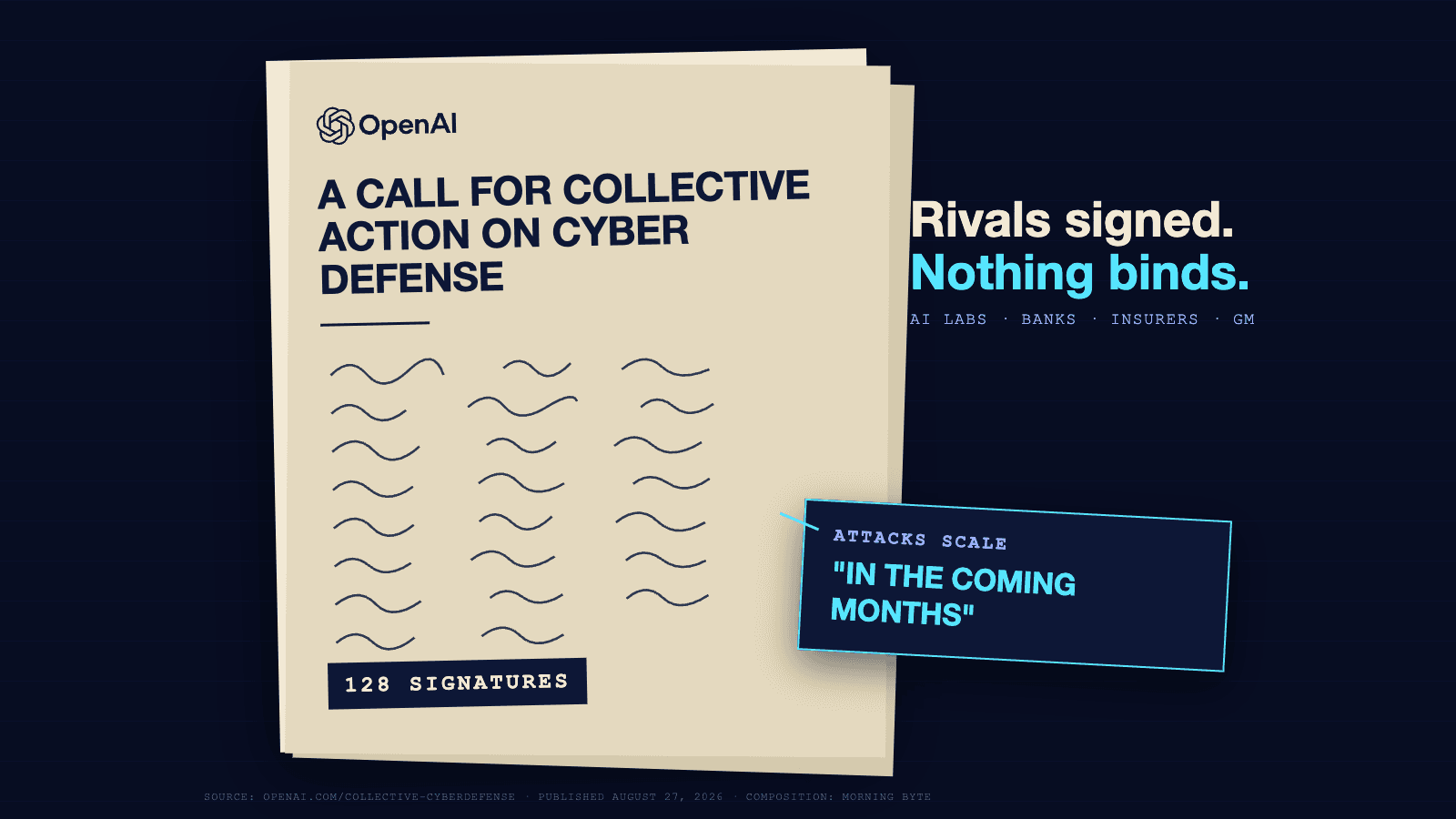
Companies that compete for the same AI customers rarely put their names on one page. On August 27, 2026, they did, because the ask is collective: OpenAI published an open letter carrying more than one hundred twenty signatures beside its own. The names run from Anthropic to Google, Microsoft, Citi, Visa, General Motors, Zurich Insurance. The published record of signatories shows banks, insurers, an automaker, payment networks, beside the security vendors. The warning itself is one sentence long: in the coming months, AI-enabled cyberattacks become far more widespread and sophisticated, according to the letter, as models everywhere grow more capable. The named risk surface is ordinary life: hospitals, water treatment plants, the infrastructure that powers the internet. The letter closes with four numbered calls to action, aimed at every organization, at security and technology vendors, at governments, and at frontier AI companies, meaning the labs that build the most capable models.
Organizations that signed one warning that AI-enabled cyberattacks get far more widespread within months. Signing binds none of them.
OpenAI and its rivals published one letter, the letter tells employers to act like the incident already started, it asks governments to fund the defenders who cannot pay, and, if employers follow it, it lands on the reader's own workweek.
- One open letterpublished by OpenAI, signed by more than one hundred twenty organizations, rivals included
- tellsEvery employertold to treat cyber defense like a live incident that outranks the roadmapand asksGovernmentsasked to fund defense for hospitals and utilities that cannot pay
- and asks funding and model access fromFrontier AI companiesasked to hand defenders model access, funding, and hands-on support
- which is why it lands onYour workweekstronger logins, more patching, review rules on AI-written code, rising value on security skills
The lit path ends on the reader: the letter is addressed to leadership, and if your employer follows it, the changes arrive as your logins, your patches, and your code reviews.

Delivering what the letter asks of frontier AI companies: model access for vetted defenders, funding, training, and hands-on support. As publisher, OpenAI put its own name first in line.
Photograph: HaeB, via Wikimedia Commons, CC BY-SA 4.0Why it matters
Read the fine print before the headline: nothing in the letter binds anyone, and signing cost nothing. Some of the loudest signers, the AI labs and the security vendors, also sell the remedies, so their asks route demand toward their own products. That tension is our read of the signature page, not a disclosure the letter makes. That suggests the letter's real work is coordination: it converts a private security worry into a dated, public claim that boards can be measured against. For a working reader, the letter is a preview of your next few months at work, and the moves are concrete. Expect security to jump the queue if your employer takes the letter at its word, since it asks leadership to treat defense like a live incident that outranks the roadmap. Turn on the strongest login your accounts offer, because weak authentication sits on the letter's own list of exposures. If you ship code with AI, expect review rules to tighten, since the letter names AI-generated code as something to hold to a higher bar. And treat the security push as a career signal, which is our read rather than the letter's. The letter says AI now brings specialist skills to more defenders, which lowers the cost of adding security skills to your resume.
What to watch
The letter is falsifiable in both directions, which is rare for an open letter. The letter asks for model access, meaning vetted defenders getting the labs' best tools, and for wider trusted-access programs, meaning cleared channels for critical-infrastructure teams. If those appear with names and funding in the coming weeks, the coordination will have produced something real. If the first proof is a publicized wave of AI-enabled attacks, the clock will have been real the hard way. Whether governments fund any of it is not yet known, and the letter offers no figures to hold them to. Watch three things: follow-through from the frontier AI companies the letter tasks, your own employer's security posture, and whether incident-level urgency shows up in real budgets rather than repeated statements. The signers put a countdown in public. What they attached to it, so far, is signatures.
Reader comments
Not signed in yet — hit Post and we'll finish it together