
Who's involved
- Federal Open Market Committee
- The group inside America's central bank that decides the country's main interest rate.
- It voted on September 16 to lift the range that rate is meant to sit in, and said the reason was inflation.
- Board of Governors of the Federal Reserve System
- The board that runs the Federal Reserve, America's central bank.
- It set the two rates the Committee does not set itself: what banks earn on money they keep at the Fed, and what they pay to borrow from it.
- Kevin Warsh
- The Chairman of the Federal Reserve.
- Warsh set the public test for raising rates nineteen days before the Committee measured against it, announced that it judged the test unmet, and submitted no projection to the Committee's published Summary.
What changed
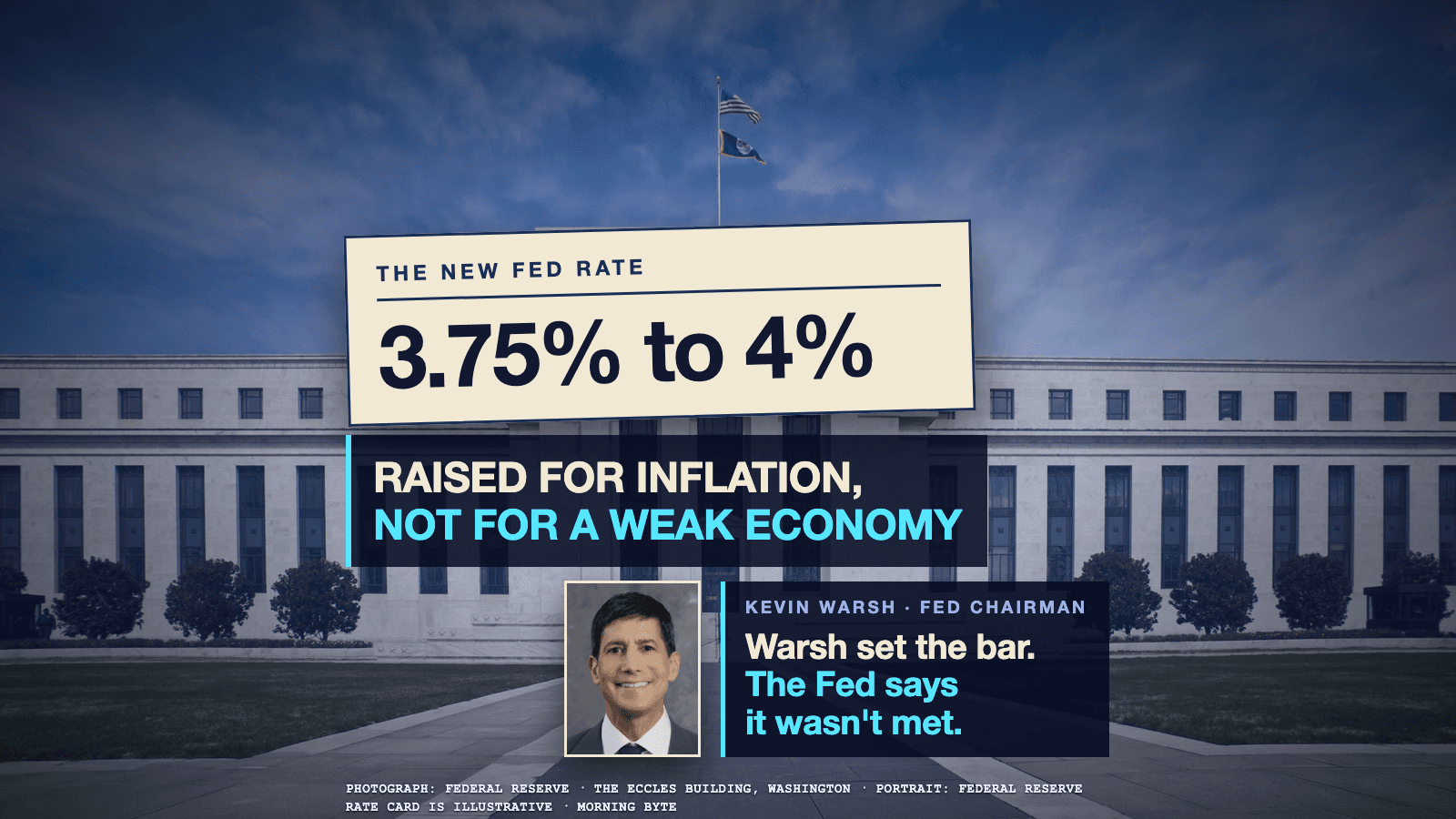
On the afternoon of September 16 the Federal Open Market Committee raised the target range it sets for the rate banks charge each other overnight. The Committee had held that range at 3-1/2 to 3-3/4 percent at both its June and July meetings. It is now 3-3/4 to 4 percent, and it took effect the following morning. The Federal Reserve's own explanation of this tool gives two reasons for raising rates: an economy that is overheating, or inflation that is too high. The Committee pointed at the second one. Its statement calls economic activity solid and domestic spending resilient.
Three of the Committee's own members had wanted this in July. The July statement was approved 9 to 3, and Beth M. Hammack, Neel Kashkari and Lorie K. Logan voted against holding the range. The statement records that all three preferred to raise it by a quarter point at that meeting, which is the move the Committee made seven weeks later. The September statement carries no dissent, and Warsh described the Committee's vote on the decision as unanimous.
Three separate moves happened at once. The Federal Open Market Committee sets the target range for the federal funds rate. The Fed describes that as an interest rate for overnight borrowing by banks. The Board of Governors, which runs the Federal Reserve, then set two rates of its own. Banks now earn 3.90 percent on money they keep at the Fed. They pay 4.0 percent to borrow from it. The Committee also directed a trading desk at the Federal Reserve Bank of New York, one of the Fed's regional banks, to run the daily operations that hold the rate inside the range.
The Chairman, Kevin Warsh, set the test in public nineteen days before applying it. At the Jackson Hole symposium in Wyoming on August 28, Warsh named a standard. "We must be confident that underlying inflation is moving to our objective, clearly and at sufficient speed." The same speech drew the line plainly. "I stand here today committed to a discipline, not to a decision." On September 16 Warsh said the Committee had decided that this standard was not satisfied.
What's at Stake
The new target range for the federal funds rate, a quarter of a percentage point above where it sat before, in force from September 17, 2026.
Market intelligence
The read: Over five years, the 10-Year Treasury Yield is up 3.54 points. Over one year, the 10-Year Treasury Yield is up 0.86 points. Over the past month, the 10-Year Treasury Yield is up. The 10-Year Treasury Yield is up 0.05 points today.
Federal Open Market Committee, Board of Governors of the Federal Reserve System and Kevin Warsh don't trade on a stock market.
Prices move for many reasons. This shows where they stand, not what caused it.
Prices: Yahoo Finance.
How We Got Here
- A new Chairman's first meeting
At Warsh's first FOMC meeting as Chairman the Committee kept the target range at 3-1/2 to 3-3/4 percent.
- Three vote to raise now
The statement was approved 9 to 3. Hammack, Kashkari and Logan voted against, preferring to raise the target range by a quarter point at that meeting.
- The standard is set in public
At the Jackson Hole symposium Warsh named the test: confidence that underlying inflation is moving to the objective, clearly and at sufficient speed.
- The Committee raises the range
The FOMC lifted the target range by 1/4 percentage point to 3-3/4 to 4 percent, and Warsh said the Committee had decided the standard was not satisfied.
- The new rates are in force
Interest on reserve balances moved to 3.90 percent and the primary credit rate to 4.0 percent.
The System Underneath
The Committee sets a target range for the rate banks charge each other overnight, the Board and a trading desk hold the real rate inside it, and other rates normally follow.
The People
- The Committee votes a target rangeThe Federal Open Market Committee sets the band the federal funds rate is meant to sit in. On September 16 it moved that band to 3-3/4 to 4 percent.
- so thatThe Board and the desk hold it inside the bandThe Board of Governors sets what banks earn on money kept at the Fed. A trading desk in New York buys Treasury bills, the government's short-term IOUs, and lends and borrows overnight to hold the rate inside the range.
- and thenOther interest rates normally move with itThe Federal Reserve says a change in the federal funds rate normally comes with changes in other interest rates and in financial conditions more broadly.
The Committee changes one rate between banks. Everything a household or a business pays or earns sits at the far end of that chain, which is why the Federal Reserve's own wording says normally rather than always.
Why it matters
The Federal Reserve's own explanation is plain about what follows. A change in the federal funds rate normally affects, and is accompanied by, changes in other interest rates and in financial conditions more broadly. Those changes then affect the spending decisions of households and businesses. Two words there carry the weight. Normally, because the Fed is stating an expectation rather than a guarantee. And other, because the rate the Committee moved is the one banks charge each other overnight. The rates a household pays or earns are among the other ones that are meant to follow.
The inflation the Committee is aiming at has run above its 2 percent goal for more than five years, by the Chairman's account. Warsh said the most recent consumer and producer price data put the twelve-month change in total personal consumption prices at likely around 3.6 percent in August. Core personal consumption prices are running at about 3.2 percent and consumer prices at about 2.4 percent. Too many categories, Warsh said, are still posting increases above 3 percent on both a six-month and a twelve-month basis. The prices of many key commodity inputs rose over the period between meetings.
The other half of the Fed's job looks healthy by its own measure. Warsh called the labor side of the Fed's congressional remit in good shape. The jobless rate is low at around 4.1 percent, job openings and weekly hours are increasing, and unemployment claims are running at levels consistent with full employment. That figure, 4.1 percent, turns up twice in this story for two unrelated things. One is the share of people looking for work. The other is where the Committee's median projection puts the interest rate at the end of this year. They are different measures that happen to land on the same number.
Who's Accountable
Naming the standard for action in public at Jackson Hole, nineteen days before the Committee measured against it. Announcing on September 16 that the Committee had decided the standard was not satisfied. Submitting no projection to the Committee's published Summary.
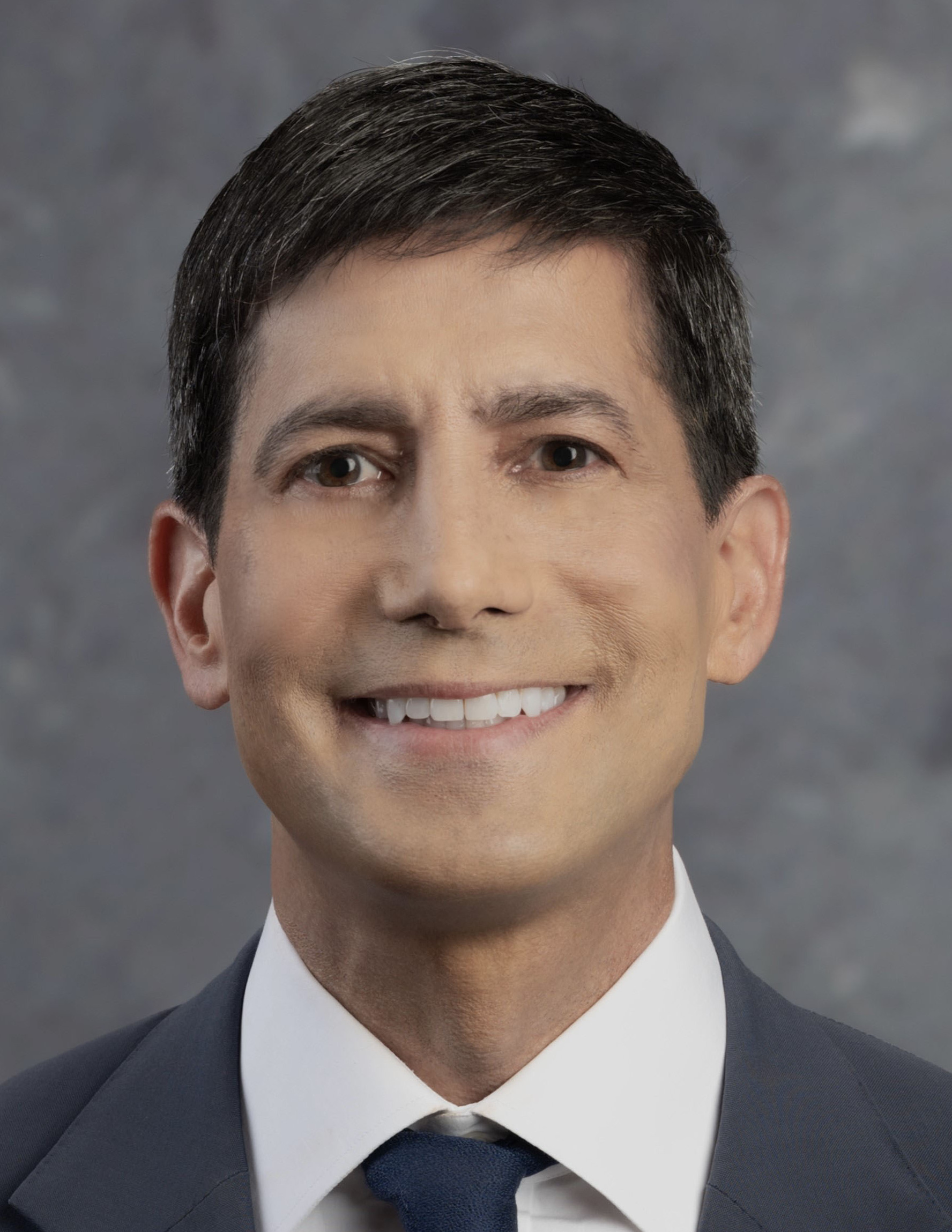
Photograph: Board of Governors of the Federal Reserve System, public domainWhat to watch
The Summary of Economic Projections came out the same afternoon. That is where the next move is written down. Its median puts the appropriate federal funds rate at 4.1 percent at the end of this year. It has the rate staying there through next year. The middle of the range the Committee just set is 3.875 percent. So the Committee's own middle view is one more step the size of the one it just took, then a stop.
The same projections expect total personal consumption inflation of 3.7 percent this year. They have it falling to 2.3 percent next year. The rate, meanwhile, sits still. Those two lines are the pair to watch together. The Committee is looking for inflation to fall 1.4 percentage points without tightening much further. It says inflation risks are to the upside while labor risks are roughly balanced.
The discovery worth keeping came from the Chairman. Warsh read out the Committee's projections and then stepped outside them. The Summary reflects the views of colleagues on the Committee, Warsh said, adding: "I have not offered a projection of my own." That has now happened twice, in June and again in September. So the median pointing to one more step is a forecast from everyone on the Committee except the Chairman who read it out.
Reader comments
Not signed in yet — hit Post and we'll finish it together